TDDev
 Framework Architecture
Multi-agent test-driven development for generating full-stack web applications from requirements.
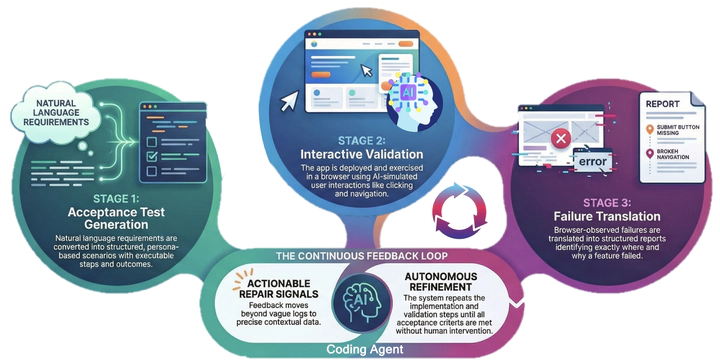
TDDev is a multi-agent framework that studies how large language model agents can generate full-stack web applications from natural-language requirements and design inputs. Instead of asking an agent to directly write an application and hoping the result works, TDDev brings a test-driven development loop into the generation process: it first turns user requirements into executable acceptance tests, then generates front-end and back-end code, deploys the application, simulates browser interactions, and uses observed failures to guide iterative repair.
The motivation is simple: a web application is not correct just because the source code compiles or the server runs. Many important requirements only become visible when the application is actually opened, clicked, typed into, and evaluated from the user’s perspective. TDDev therefore treats testing, interaction, and feedback as first-class parts of automated software generation.
Key ideas
- Requirement-to-test translation. Convert high-level user requirements into structured, executable tests before code generation.
- Multi-agent development workflow. Separate responsibilities such as requirement analysis, test generation, implementation, validation, and repair across specialized agents.
- Full-stack validation. Evaluate both front-end behavior and back-end functionality rather than only static code or isolated UI screenshots.
- Browser-based feedback loop. Deploy generated applications, simulate user interactions, observe failures, and translate them into actionable repair signals.
- TDD strategy study. Compare different test-driven development protocols and show that the best strategy depends on the generation style of the underlying model.
Why it matters
LLM coding agents are becoming increasingly capable at producing runnable software, but “runnable” is not the same as “shippable.” A generated web app may start successfully while still missing key features, violating user requirements, or breaking under realistic interactions. TDDev explores how automated testing and feedback can close this gap, moving web-app generation from one-shot code synthesis toward an autonomous development loop that resembles real software engineering practice.
Alex Jiakai XU
CS PhD Student
My research interests include computer systems, programming languages, software architecture, and cyberspace security.