Evaluating a Terminal Task Is Itself a Terminal Task: What LLM Graders Need to Judge Agent Work
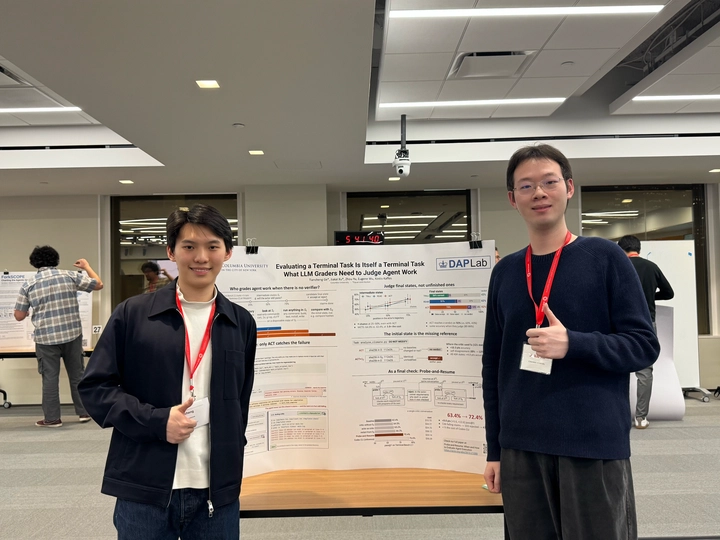 Poster presentation at AgentEvalSci 2026
Abstract
Benchmarks grade agents with verifiers written in advance, but when no verifier is available, an LLM critic must judge the agent’s work. We ask what such a critic needs to grade terminal tasks, whose outcome depends on files, processes, and services that the agent’s trajectory may not fully show. On all 89 tasks of Terminal-Bench 2.1, we vary when the critic judges, what environment access it has, and what reference it receives, and we compare its verdicts with the benchmark’s verifier. All experiments run on Waypoint, a branchable execution environment. Judging unfinished work is hard - critics rank intermediate states only modestly better than chance, even with full access to the environment. Judging finished work goes better when the critic can run its own checks. A critic that may run any command, including tests, in a disposable fork of the final state, checks every requirement and gives a verdict on 92% of states, significantly more than critics that only read the trajectory or inspect the fork. A fork of the initial state also improves accuracy, because the critic can check requirements that refer to the original environment. Used as a final check before the agent submits, the critic raises pass@1 from 63.4% to 72.4%. In short, evaluating a terminal task is itself a terminal task.

Alex Jiakai XU
CS PhD Student
My research interests include computer systems, programming languages, software architecture, and cyberspace security.